
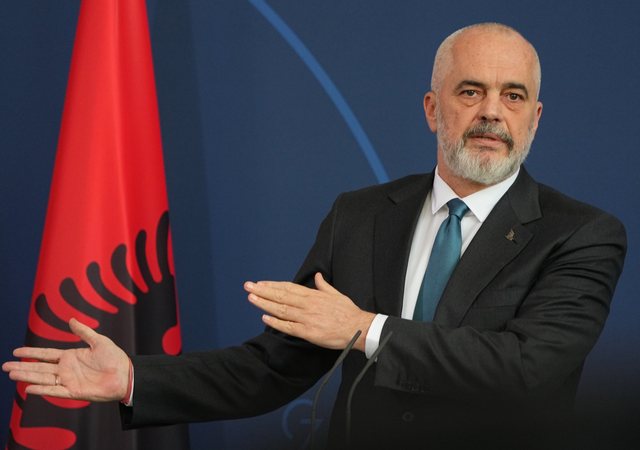
Sebi Alla In a long monologue, where he raised questions and answered them himself, Prime Minister Edi Rama used the time spent traveling in the car and then in the office to call the request of the National Association of Judges of the Republic of Albania for a salary increase as “madness”. The matter is in the Constitutional Court and the magistrates of the two levels of the judiciary, in interpreting the laws and some DCMs, are requesting indexation and calculation of the salary in changing the reference, from that of the President to that of senior civil servants of the public administration.
The portfolio of this request goes to about 37 million additional euros, an amount that the judges claim (in their request filed with the Constitutional Court) is smaller than the economic damages and negative effects ascertained each year by the High State Audit. On the other hand, Prime Minister Rama said that, “it is unacceptable and it is incomprehensible to impose on the Parliament and the government through the judicial power and to increase the salaries of themselves, the judges through the trial. You have the arrogance of a power that you treat as an unlimited power, as an uncontrolled power”.
The debate has meanwhile devolved into legal interpretations and clashing statements between the head of government and the judges’ association.
The process
In March of this year, the National Association of Judges of the Republic of Albania sent to the Constitutional Court the request for the “Abolition as incompatible with the Constitution of the Republic of Albania of articles 1 and 2 of law no. 33/2023 “On an amendment to law no. 96/2016 “On the status of judges and prosecutors in the Republic of Albania”.
Both references that are being sought to be overturned relate to the basic reference salary for judicial and prosecutorial functions, which is the same as multiplying the coefficient 0.36 by the salary of the President of the Republic.
The head of this association, Erigert Pëllumbi, also a judge at the Court of Appeals against Corruption and Organized Crime, told Faktoje.al that what is being requested is not a salary increase, but that they have objected to the incorrect calculation of their salary. “It is not about an increase, but about an incorrect calculation of the salary with the effect of reducing it, as a result of the change of reference from the public administration to the President of the Republic,” said Pëllumbi.
Reaction, after reaction
“They are demanding a 1,800 euro increase for the First Instance judge, a 2,000 euro increase for the Appeals judge, and a 3,000 euro increase for the SPAK and BKH judges. SPAK has not joined this absurd initiative, and this naturally earns them respect.”
“Here we are, we are in a situation where judges must impose themselves on the parliament, on the government, on the other two branches of government, they want to receive salaries according to their own opinion,” Rama said on Tuesday morning. On the afternoon of the same date, the judges’ association also reacted in a long statement, giving the issue ample elements from both sides in a “propaganda clash.”
The Judges’ Association took a stand, frequently using the term “bad faith” in the statement; “history of recidivism”; “infringement of the dignity of magistrates”, “lack of sincerity”, or “public threat”, all of which, according to it, were on the part of the government, creating the narrative that the government had acted with malicious intent and not simply with questionable legal decisions. “…we cannot remain silent in the face of the prime ministerial, public, media, completely hysterical, brawl, which aims to ignite opposition in public opinion for a decision-making and constitutional process that should take place in the courtroom.
“In this entire government and media-multiplied campaign, incited day by day to create populist fury against a constitutional judicial process, some historical facts must be mentioned, which are neglected to be cited, intentionally by some and by the understandable ignorance of others,” the position of the judges’ association states.
Rama
The prime minister’s response was long, even more “accusatory” and “populist” and heavily propagandistic.
In an accusatory tone, the head of government describes the Judges’ Association as “illegal”, “arrogant”, “scoundrels”, “bloodsuckers of the system”, etc.
A strong emotional language that aims to discredit the opponent with questions like “who are you?” and indirectly portrays them as “arrogant and outside the constitutional role.”
“…You say that we have made our financial position difficult? These are lies! Produce a document. Make public statements when you really have moments when your position is being violated by some force. But this government is the guarantee for your life and your work. You are totally independent. Are you impartial? You should look at this in yourself, not go out in public and make flashy statements”, Rama maintained . Along with accusations, assumptions, and question marks raised in every statement, the head of government did not fail to emphasize that “the justice reform was carried out by his government”.
Legal arguments
Beyond the strong positions, especially from the head of government, who for almost a year has been launching accusations against the prosecution and the judiciary, especially against SPAK and GJKKO, there is a legal issue in the Constitutional Court, related to the treatment of judges’ salaries. Although the issue of “salary indexation” and the change in the method of calculation, “reference”, has recently been made public, the allegations are older.
With the 2016 constitutional amendments for the new justice reform, the entire system moved to a different treatment, where the salaries of judges and prosecutors and the supporting part of justice institutions increased, but with unequal treatment.
The most highly rated were the SPAK Special Prosecution Office and the BKH agents, the latter with an even higher salary than judges of the special courts of first instance and appeal.
A year after the reform, the Constitutional Court repealed provisions that created unequal financial treatment for judges. More specifically, in 2022, the Constitutional Court repealed Article 12, point 5, letter “a” of Law No. 96/2016 (amended by Law No. 50/2021), emphasizing that the salary of judges must be protected from unfair reductions and maintain the relationship with the civil service.
When they were expecting “changes in salaries” (their increase), Law No. 33/2023 decided that the reference salary of judges would be calculated as 0.36 of the salary of the President of the Republic, separating it from the reference to the civil service. The Prime Minister, for his part, said that there would be no salary cuts.
Timing
There has also been “understanding and silence” between the government and judicial parties, analyzing the entire process related to financial treatment, but somewhere in essence, Law 33/2023 is claimed by the judges to have been made in violation of honesty and bad faith.
The Association of Judges claims that the draft law drafted by experts provided for higher salaries (about 1/3 more), but the Parliament, according to them, changed it without debate, deviating from the standards of the reform. On the other hand, the head of government denied this on Wednesday, saying that the law was strongly supported by the deputies and there is no truth in the claim that it deviated from the initial version. He describes it as a political decision adopted by consensus, not in bad faith.
It is precisely this law that the judges’ association opposes and the decision-making will be up to the Constitutional Court, but recent statements by the parties in the process, the judges and the government, have channeled the issue into a strong clash of positions, which seems likely to continue.