
Since the pandemic, the number of parents refusing to vaccinate their children has increased significantly. Vlora, Lezha and Tirana are the hottest spots for this phenomenon, with the most alarming percentages of unvaccinated children. Disinformation and conspiracy theories on social media are challenging public health, as experts warn that restoring vaccination coverage above 95% is vital, otherwise the risk of epidemic outbreaks remains inevitable.
Sebi Alla
Nearly 18 percent of children in the Vlora Region did not receive the mandatory vaccine for 2024, while in other large districts, refusal remains high. Data on vaccination coverage in the country in the period 2015-2024, provided to Faktoje.al by the Institute of Public Health (ISHP), raises concerns that vaccination in the country since the time of the pandemic and onwards has been declining.
In cases of measles and other infectious diseases in pediatric age groups, it has been proven that children have refused vaccines and this phenomenon is expanding, despite the fact that the vaccination service remains covered throughout the country and authorities say that awareness has increased.
One of the main measures to force parents to vaccinate their children is to prevent them from registering in daycare centers, kindergartens, and schools. If they do not present a completed vaccination card, children cannot be registered. However, this rule does not apply to the private sector.
“During 2025, a measles outbreak was identified with several cases in a private kindergarten in Fier, where it was found that the affected children were unvaccinated. This case highlights the need to strengthen control and implement vaccination criteria uniformly, both in the public and private sectors,” epidemiologist Rovena Daja, an expert at the Institute of Public Health, tells Faktoje.al.
Fear of autism
The increase in cases of autism in the 2-3 year old age group has often been linked by parents to vaccinations, but this theory without scientific basis, accompanied by uncritical publications on social media of statements by “conspiracy theorists”, in addition to confusion, has led to refusal of vaccination of children by some parents.
“According to official assessments by the Institute of Public Health (IPH), the vaccines that most often encounter problems in their implementation are the FRP (Mumps-Rubella-Parotitis) vaccine and the HPV vaccine. One of the most prominent controversies is related to the FRP/MMR vaccine and the claim that it causes autism,” says Rovena Daja, an epidemiologist and expert at the Institute of Public Health, to Faktoje.
According to her, this claim originates from an article published in 1998 in the journal The Lancet by Andrew Wakefield, which was later retracted due to serious ethical and methodological violations.
“This publication, plus many cases of publications without scientific basis, or based on conspiracy theories, are some of the reasons why parents refuse to vaccinate their children,” says expert Daja.
“Regarding the HPV vaccine, it is perceived by some parents as the ‘new vaccine’ in Albania. In fact, this vaccine has been used globally for more than 20 years, with a high safety profile and efficacy in preventing cervical cancer and other HPV-related diseases,” she adds.
Vaccination with fear
In an observation made by Faktoje. al in kindergartens in Tirana, parents say that they are often hesitant about vaccination, somewhat postponing the injection of doses determined in a strict calendar by health institutions. However, others admit that they have heard, even in the nurseries and kindergartens where they have their children, that some parents refuse to get vaccinated.
“I know some who are very worried and still haven’t gotten it. The child is 3 years old and they still haven’t gotten it (the vaccine). Personally, I haven’t been worried about this at all,” says a young mother.
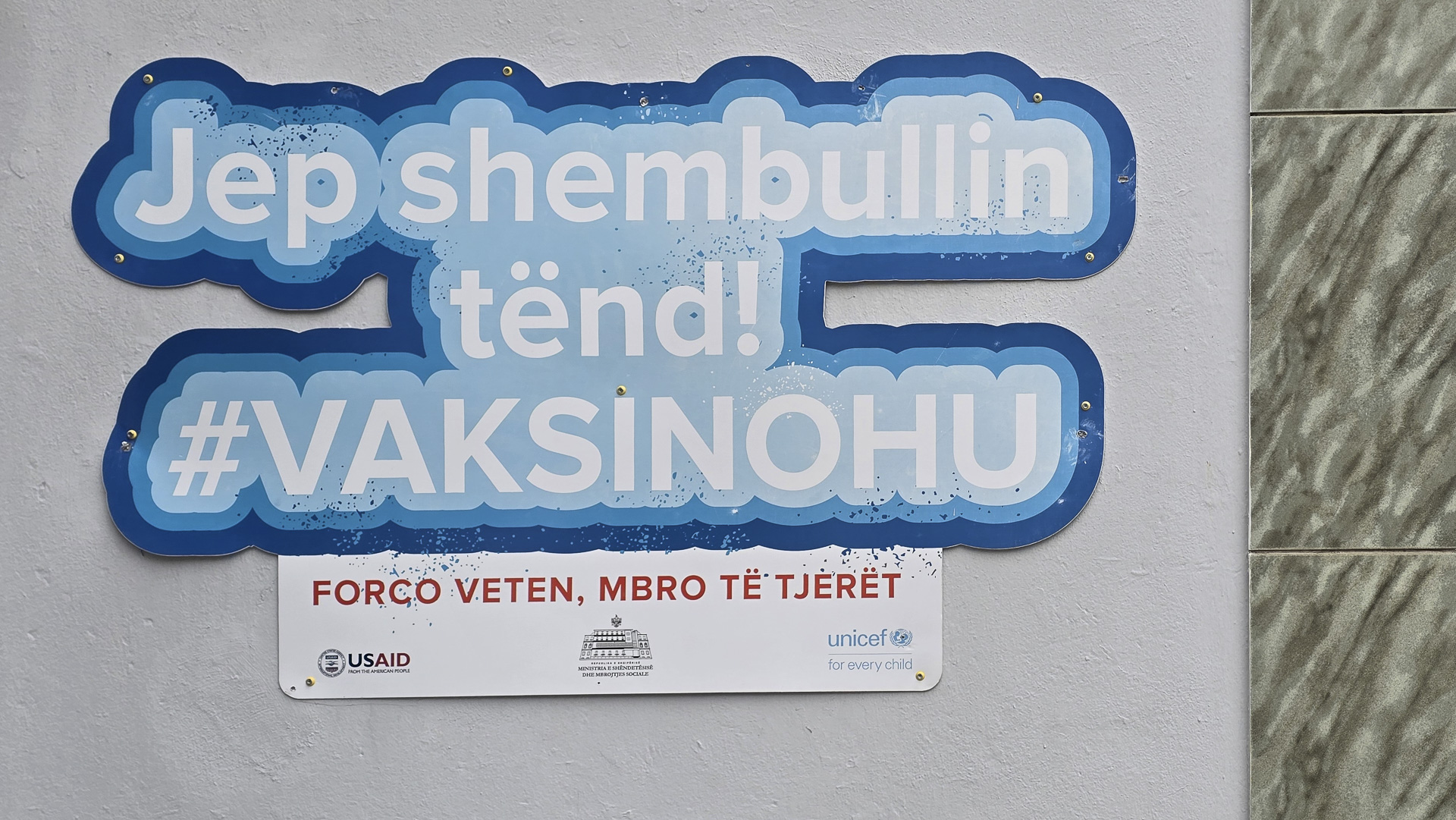
A combination of parental fear coupled with disinformation received on social media, mainly from unconfirmed and non-scientific sources, has led to a problem in vaccinating children in our country since the start of the pandemic.
“The vaccines that most often present problems are: the MMR vaccine (against measles, rubella and mumps), the first dose of which is administered at 12-15 months, and the HPV vaccine which is administered at 13 years of age,” the IHP tells Faktoje.
According to this institution, given the decrease in the number of vaccinated children since the pandemic period, work has been done with increased awareness, as well as permanent recommendations from pediatricians to raise awareness among parents about timely and complete vaccination according to the calendars set by health institutions.
The most problematic districts
According to data from the IHP, the region with the highest vaccination rate is Dibra. Even during the pandemic, the vaccination rate has been quite high, reaching 100 percent for several consecutive years.
A completely different situation is in the Vlora region with a high population. In particular, the year 2024 is considered the most problematic, where 82.3 percent of children received the vaccines, while 17.7 percent refused. For experts, this is considered a very high and worrying figure. Also in previous years, for the years 2021-2023, it fluctuated between the figures of 87-90 percent with vaccine coverage.
After Vlora, another region with problems in vaccination is considered Lezha. The downward trend began during the pandemic period and has maintained the same curve for the following years, reaching figures of up to 96 percent.
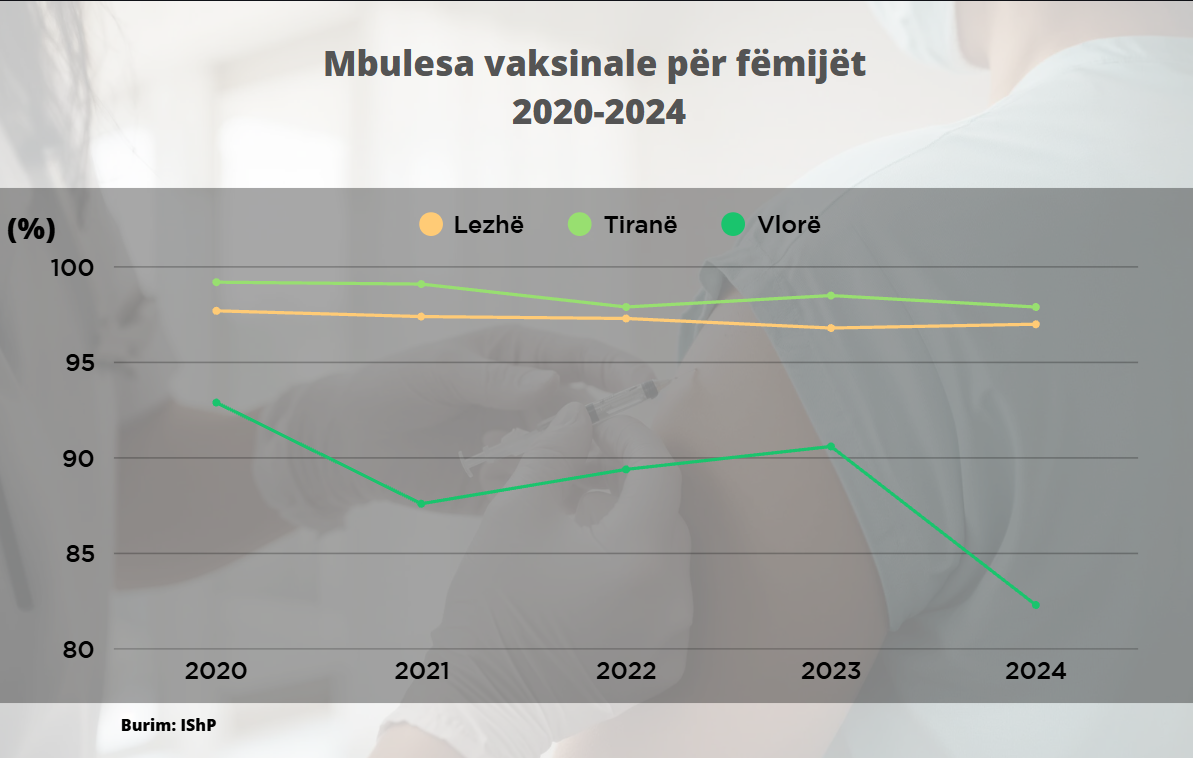
Similarly, in Tirana and Shkodra, approximately 3-4 percent of children are unvaccinated, a problematic figure considering the high number of residents in both regions.
“The COVID-19 pandemic has had a significant impact on vaccination programs not only in Albania, but is a phenomenon observed globally. In the post-pandemic period, the National Vaccination Program has organized awareness and information campaigns for parents, conducted training and sensitization activities with medical staff, with a focus on communicating with parents hesitant to vaccinate. These activities are currently ongoing, with the aim of restoring and maintaining vaccination coverage above 95% according to WHO guidelines,” says the IHP.